
A modest lift, without surgery
A PDO thread lift places dissolvable sutures under the skin with a cannula: barbed threads to lift the jowl or cheek, smooth threads to build collagen. Plan on forty-five to ninety minutes under local anesthetic, two or three tender days, and a peak at month three. Manufacturers market 12 to 18 months. Published reviews say the lift holds several months to about a year and the texture benefit lasts longer. At Skinovatio Lincoln Park, on Lincoln Avenue north of Wrightwood, we’ll assess what you can expect for your face.
Consult
priced at your visit
At a glance
PDO thread lift- Appointment
- 45 to 90 minutes, local anesthetic at entry points
- Downtime
- Swollen and tender 2 to 3 days, mostly settled by day 7
- First results
- Repositioning on the day, under swelling
- Full results
- Month 3, when collagen peaks
- Sessions
- 1, repeated at 12 months or when the lift fades
- Cost
- Priced at your consult. Financing available.
What to expect
What the appointment is like
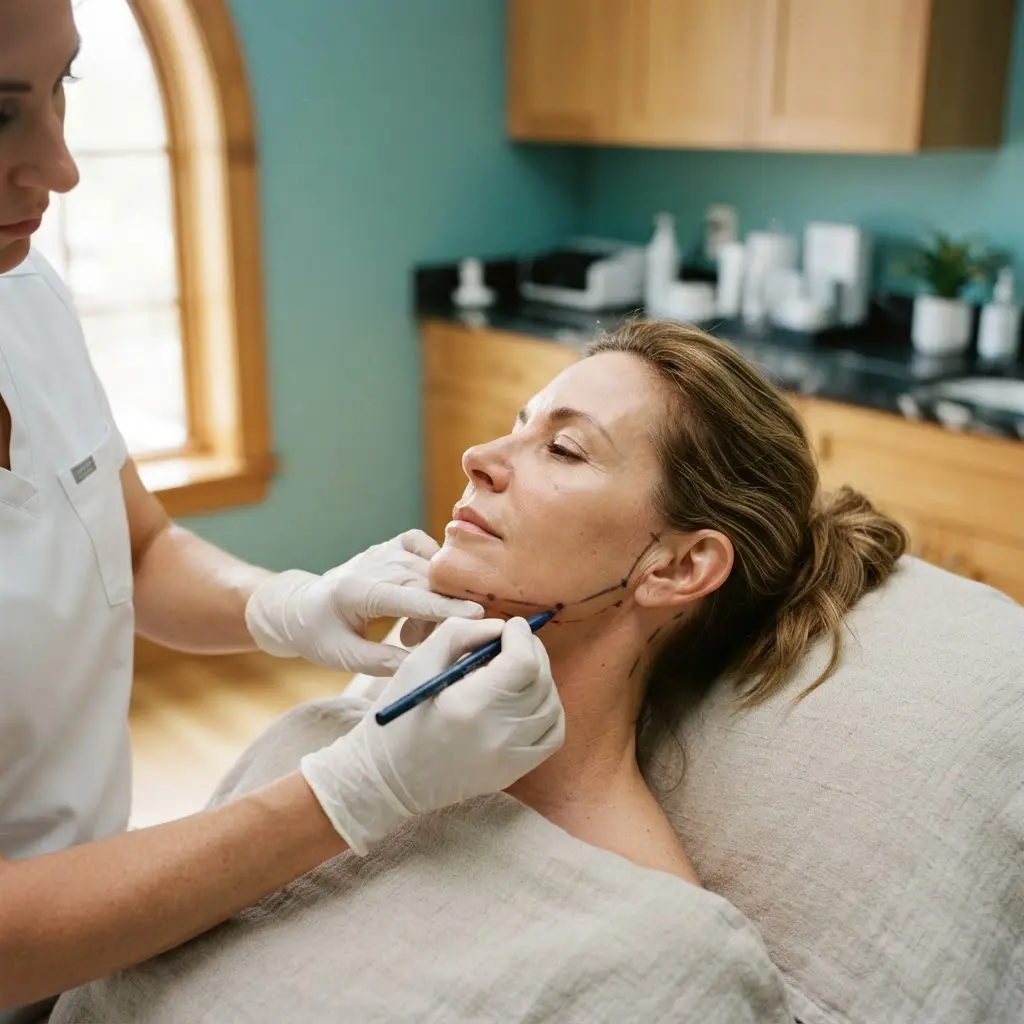
Your injector marks the vector lines while you sit up, so the plan accounts for gravity. Local anesthetic goes in at each entry point and along the thread path. Barbed threads are fed through a cannula and set with a gentle pull. You’ll feel pressure, tugging, and a pulling sensation as the barbs engage. Smooth threads go faster. Entry points are small marks at the temple and along the jaw, and sunglasses can cover the temple marks afterward.
Consult
You’ll sit up and look straight ahead while your injector shows you the lift with two fingers. If the lift you need is measured in centimeters, we’ll recommend a surgical consultation.
Numbing
Lidocaine injections at each entry point and along the thread path. It’s the most uncomfortable part of the visit, and it’s brief.
Treatment
Barbed threads go in through a cannula and are set with a pull, and smooth threads are placed in a mesh. Plan on 45 to 90 minutes, depending on how many areas.
Before you leave
Ice, written aftercare, and no dressing. We’ll take a photo for the record and book your check at week 2.
Your results
A predictable timeline
The repositioning is there on the day, though swelling hides it for about a week. The collagen effect builds over two to three months, which is the best time for comparison photos. After that it settles rather than grows, and the lift fades over months to about a year. The review above noted the longest follow-ups were at two years and that long-term efficacy data are lacking. A 2021 meta-analysis of 26 studies found satisfaction fell from 98 percent immediately to 88 percent later. Individual results vary. For a year-by-year breakdown, see how long PDO threads last.
Day 0
Lifted and swollen, with entry marks at the temple and jaw.
Day 3
Tender to chew, and any puckering is settling.
Day 7
Swelling has largely resolved.
Week 2
Your check visit. We’ll address any asymmetry now.
Month 3
Peak result. The collagen track has formed, and this is when we take comparison photos.
Months 6 to 12
The lift softens, while the texture benefit holds.
Month 12
Repeat if you’d like the lift back, or move to Morpheus8 for maintenance.
What it costs
Clear pricing, planned by the visit
Four things shape your total: how many threads and which type (barbed threads cost more than smooth), how many areas (midface, jawline, neck, brow), the local anesthetic, and whether filler or a neuromodulator is combined in the same visit. A jawline alone is the smallest plan. A midface plus jawline with a smooth-thread mesh in the neck is the largest.
- How many threads
- Barbed lifting threads versus smooth
- How many areas
- Whether filler or Botox is added the same visit
At Skinovatio Lincoln Park
PDO thread lift
Consult
priced at your visit
- Consultation
- $50
- Financing
- Cherry, Affirm, Afterpay
PDO threads aren’t on the Lincoln Park online booking menu. Ask about them at your consult to book.
Book your PDO thread lift appointmentSimilar purpose, different options
Threads or something else?
Here are the two alternatives we offer for the same concern.
Morpheus8 tightens the skin itself with radiofrequency over three sessions, no threads under the skin, and its result grows over three months instead of settling. It doesn’t reposition anything. For a soft jaw, we often combine the two: threads first, then a Morpheus8 series. If you start both in January, they peak together by late spring.
Dermal fillers replace volume where it has gone, but they don’t lift. If the fold is deep because the cheek dropped, we’d start with threads, then use filler for what’s left. Combined HA filler and barbed threads showed measurable contour change at 24 months in a small 11-patient study. For a neck that has texture rather than descent, Forma is the no-downtime option.
Is it right for me?
Who it’s for, and who it isn’t
The best candidates are usually 35 to 55, with mild to moderate sagging and decent skin thickness. That’s the population the studies treated, and it’s where the dimpling and infection rates are lowest. In the 2021 meta-analysis, older patients had a significantly higher rate of dimpling (16 percent versus 5.6 percent) and infection (5.9 percent versus 0.7 percent).
A good fit for
- Mild to moderate sagging, not ready for surgery
- Early jowls or a softening jawline
- Good skin thickness
- Anyone wanting position plus a collagen effect
Not recommended
- Heavy jowls or very loose neck skin (surgery fits better)
- Sag that is really deflation (filler fits better)
- An active infection near the site
- During pregnancy or breastfeeding
Threads reposition tissue mechanically; Morpheus8 firms the skin over a jowl without moving it. Many people alternate, threads for position, Morpheus8 between rounds for the skin.
In detail
What it treats
Threads do two different jobs depending on the thread. Barbed (cog) threads grip tissue and hold it higher. Smooth (mono) and twist threads are placed in a mesh to stimulate collagen without lifting. Here’s how they’re used by area.
This is the main reason people book. Barbed threads anchored near the ear pull the early jowl back along the mandible. It works when the jowl is small and the skin still has some thickness.
Barbed threads lift a cheek that has started to slide toward the nasolabial fold. Lifting the cheek softens the fold below it, which is why we’ll check your cheek before recommending filler for a fold.
Small barbed threads placed at the temple lift the tail of the brow a few millimeters. It’s an outer-brow effect, not an eyelid surgery, and it suits a brow that has dropped rather than lids with excess skin.
Smooth threads across the front of the neck improve crepey texture, for mild laxity only. A loose neck with platysmal bands is better treated surgically.
Smooth and twist threads in a mesh under the cheeks, jawline, or neck build a collagen track as the thread dissolves. There’s no lift, just better texture and firmness, sometimes repeated over 2 to 3 sessions.
How it works
PDO is polydioxanone, an absorbable surgical suture material. Barbed threads anchor in the subcutaneous tissue and hold the cheek or jowl slightly higher from the day of placement. As the PDO dissolves over months, the tissue around each thread forms a fibrous, collagen-rich track that gives a modest, longer-lasting firmness effect, per a 2025 systematic review of 12 studies.
PDO threads are 510(k)-cleared as absorbable sutures, Class II, and one clearance covers face suspension surgery to “temporarily” fixate the cheek subdermis in a raised position, per the FDA clearance record. Note the word “temporarily.” No thread is cleared to lift the neck, brow, or jowls by name, and “non-surgical facelift” is a nickname, not a cleared indication. Feel free to ask us which thread brand we use.
| What it does | Where | How long the effect lasts | |
|---|---|---|---|
| Barbed (cog) | Grips and repositions tissue on the day | Jowl, cheek, brow tail | Lift fades over months to about a year, collagen track lasts longer |
| Smooth (mono) | Collagen stimulation, no lift | Neck, cheeks, jawline, under the chin | Texture benefit builds over 2 to 3 months, holds beyond the lift |
| Twist (screw) | Collagen plus mild volume in a fold | Nasolabial and marionette area | Similar to smooth, slightly more fill |
Barbed (cog)
- What it does
- Grips and repositions tissue on the day
- Where
- Jowl, cheek, brow tail
- How long the effect lasts
- Lift fades over months to about a year, collagen track lasts longer
Smooth (mono)
- What it does
- Collagen stimulation, no lift
- Where
- Neck, cheeks, jawline, under the chin
- How long the effect lasts
- Texture benefit builds over 2 to 3 months, holds beyond the lift
Twist (screw)
- What it does
- Collagen plus mild volume in a fold
- Where
- Nasolabial and marionette area
- How long the effect lasts
- Similar to smooth, slightly more fill
Afterwards
Downtime and aftercare
Here’s what to expect, day by day. Day 0 to 1: swollen and tight, with visible entry marks, and sometimes puckering along the thread that is expected to settle. Day 2 to 3: tender when chewing, still swollen, possibly with a bruise or two. Day 7: swelling has largely resolved. Patients on RealSelf report mild swelling and bruising for up to a week and most return to work the next day, per RealSelf, patient-reported. Puckering usually resolves within a week.
For the first week, sleep on your back with your head raised, avoid wide mouth opening, gum, and hard foods, and limit big expressions for 48 hours. Please avoid rubbing, facials, and massage for 2 to 4 weeks. Hold off on strenuous exercise for a week and dental work for two. Please tell us about blood thinners and supplements beforehand, and skip aspirin, ibuprofen, fish oil, and alcohol for a few days if your doctor agrees.
Why here
Why Lincoln Park
You’ll find us on Lincoln Avenue just north of Wrightwood, a block up from the Apollo Theater. Take the Brown Line to Diversey, then head south on Lincoln, or the Red, Brown, or Purple Line to Fullerton, then head north. The 11 Lincoln bus runs right past our door. There’s no dressing after a cannula lift, so you can head home with an ice pack. There are meters on Lincoln, and free spots on the side streets west of Clark (check the street cleaning signs).
For a wedding, plan on 6 to 8 weeks out, so the swelling and the settling are both done. Winter is a good time to start a thread lift paired with a Morpheus8 series, since sun exposure is lower from November to March. Your threads are placed by our nurse practitioner under medical direction.
Questions
Common questions, answered
A thread lift places dissolvable polydioxanone (PDO) sutures under the skin through a cannula. Barbed threads grip tissue and hold the cheek or jowl a few millimeters higher. Smooth threads build collagen without lifting. It takes 45 to 90 minutes under local anesthetic, with a swollen, tender week after. The lift holds several months to about a year, and the texture benefit lasts longer.
Manufacturers market 12 to 18 months. A 2025 systematic review of 12 studies said long-term efficacy data are lacking, and patients commonly report 6 to 12 months. Plan on the lift holding several months to about a year, with the collagen benefit outlasting it. Individual results vary.
It depends on the number and type of threads (barbed cost more than smooth), how many areas are treated, and whether filler or a neuromodulator is added the same day. A jawline alone is the smallest plan. Your consult gives you a written thread count and price.
Barbed (cog) threads have tiny hooks that grip tissue and reposition it, so they lift. Smooth (mono) threads have no barbs and are placed in a mesh to stimulate collagen, so they firm and improve texture without moving anything. Most jawline plans use barbed threads for the lift and smooth threads for skin quality.
The brow tail, yes, by a few millimeters with small barbed threads at the temple. The neck, only for mild laxity and texture with smooth threads. A loose neck with visible bands is better served by a surgeon. No thread is FDA-cleared to lift the brow or neck by name, so these are off-label uses of a cleared suture.
Sometimes, for the first few weeks, especially over the cheekbone where skin is thinner. In pooled data from 26 studies, thread visibility or palpability occurred in about 4 percent of cases. It settles as swelling resolves and the thread softens. If it’s still visible, we’ll check it at your two-week visit.
No. PDO dissolves on its own over several months, leaving a collagen track behind. Removal is only done if a thread extrudes or migrates, which happened in about 2 percent of pooled cases, and it’s a quick in-office procedure.
Wait a week. Strenuous exercise increases swelling, and the impact can shift a fresh thread. Walking is fine from day two.
Yes, it’s another name for the same procedure. “Non-surgical facelift” is a marketing phrase, not an FDA-cleared indication. Threads reposition tissue by millimeters and hold for months to about a year. A facelift moves tissue by centimeters and holds for years.
No, if there’s early sagging to lift. Early jowling or a soft jaw at 35 is exactly what barbed threads handle best, and younger, thicker skin has the lowest dimpling and infection rates in the published data. If nothing has dropped yet, a smooth-thread mesh for collagen or a Morpheus8 series is the better first step.
The threads dissolve on their own in about six months, and the lift fades with them. Placement can’t be changed in the meantime, which is why we keep a first treatment conservative.
Keep exploring
Related treatments
Related priorities
Start with a consult
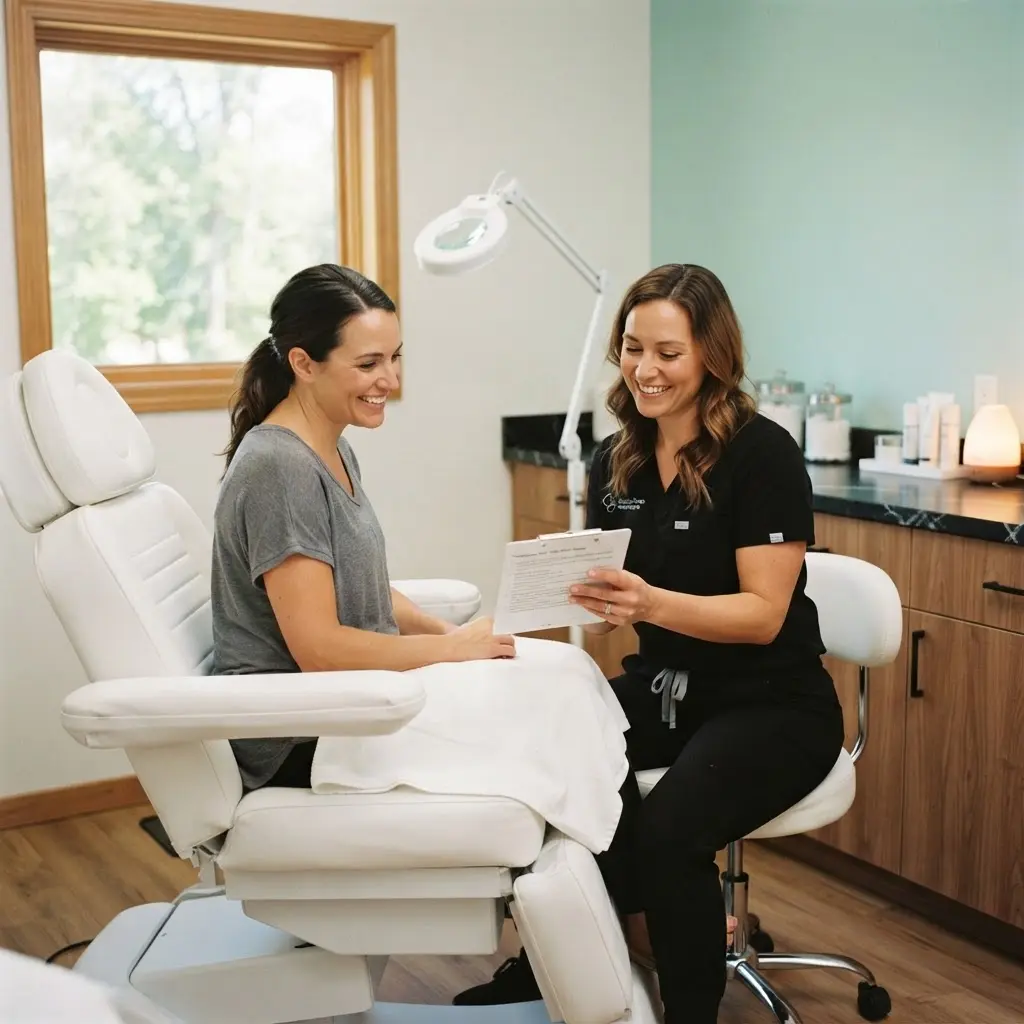
Tell us what you’d like to work on. We’ll assess your skin and goals, walk you through your PDO thread lift options, and give you a clear plan and price before anything begins.
Afterpay and Klarna are available at checkout for eligible treatments.