
Thicker-looking hair, from your own blood
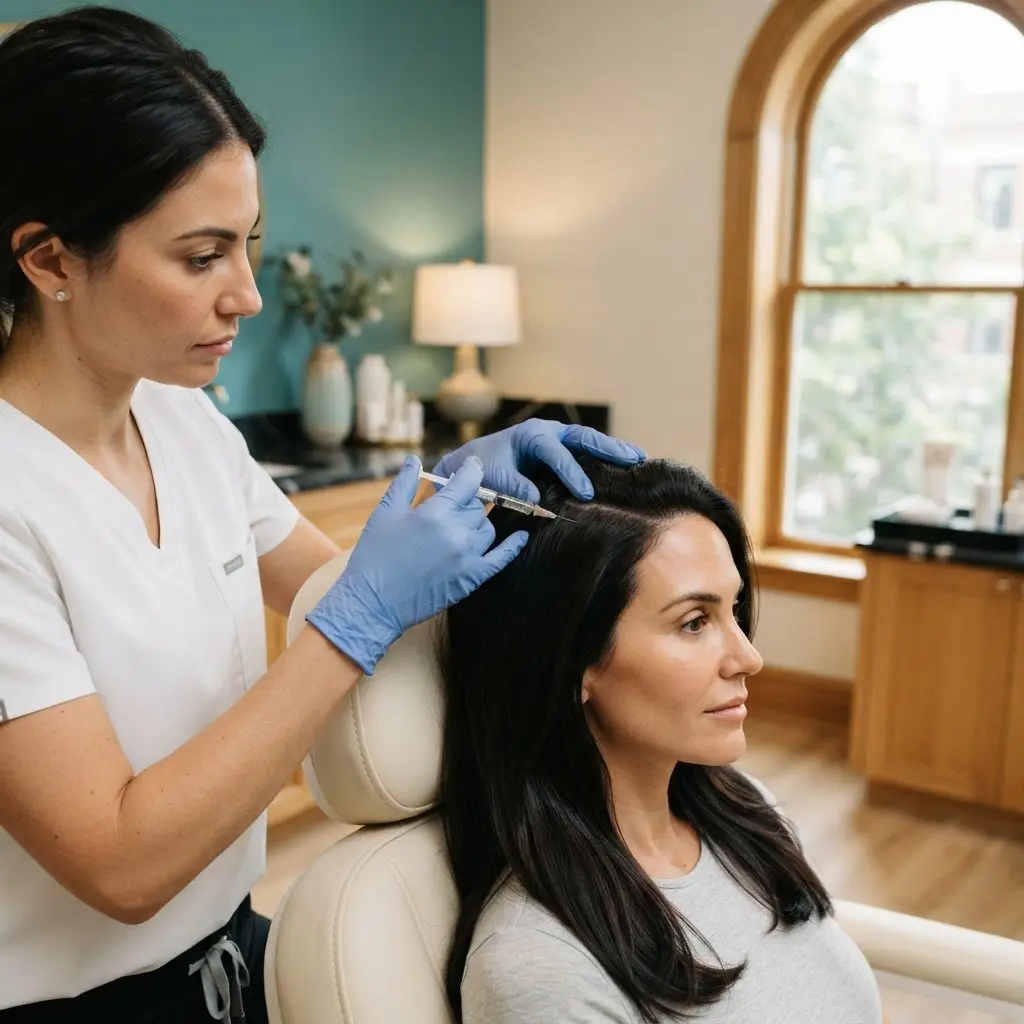
PRP hair restoration is one blood draw, a 10 to 15 minute spin in a centrifuge, and 15 to 20 minutes of injections across the thinning zone. Plan on about an hour in the chair at Skinovatio Lincoln Park. You’ll start with three monthly sessions, then move to boosters. It’s for men and women with pattern thinning, where the follicles are smaller but still alive.
$800
to start
At a glance
PRP hair restoration- Appointment
- About an hour, topical numbing
- Downtime
- Tender scalp for a day, no dressing, no washing overnight
- First results
- Less shedding by month 2 to 3
- Full results
- Density judged at month 6
- Sessions
- 3 monthly, then boosters every 3 to 6 months
- Cost
- From $800. About $200 per payment across 4 with Afterpay or Klarna.
What to expect
What the appointment is like
Arrive with clean, dry hair. Your provider photographs the area from fixed angles, marks the zone, and applies numbing. The blood draw is one tube from your arm.
Consult and photos
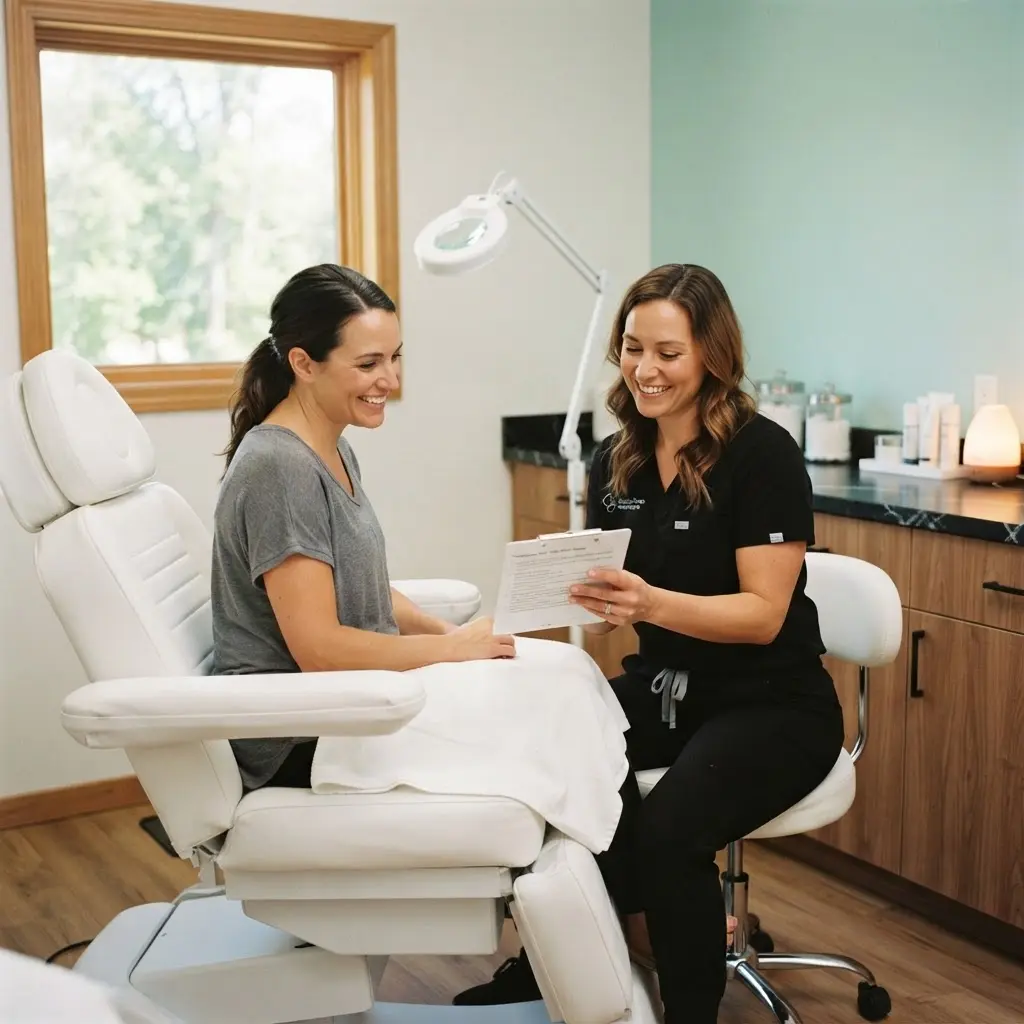
Your provider maps the pattern, confirms follicles are still present, and takes baseline photos from fixed angles.
Draw and numbing
One tube of blood from your arm while topical numbing sits on the scalp.
Spin
10 to 15 minutes in the centrifuge to separate the platelet-rich layer.
Injections
15 to 20 minutes across the marked zone. You’ll feel pressure and a sting each time, and any bleeding stops before you stand up.
Before you leave
No dressing is needed. We’ll review aftercare, including no washing until the next day and no heavy sweating for up to 48 hours, and book your next two sessions.
Your results
A predictable timeline
The first thing you’ll likely notice is that shedding slows. Then, around month three, the part or the crown starts looking denser. Density changes were most commonly reported after the third month in the reviewed trials, so allow about four months to see a difference. We’ll compare photographs together at six months, when changes are easier to see side by side.
Day 0
Tender scalp, damp roots, and no dressing. You can go straight back to work.
Weeks 1 to 4
Your second session at the one-month mark. Shedding may be lighter already.
Month 2 to 3
Your third session. Less hair in the drain, which is the first thing many people notice.
Month 3 to 4
Density starts to show at the part or the crown.
Month 6
Photo comparison against your baseline shots.
Month 6 to 12
Boosters every 3 to 6 months to hold what you’ve built.
What it costs
Clear pricing, planned by the visit
A few things shape your cost: how many sessions are in the plan (a first year is typically four to six visits), PRP alone versus PRP with the PRF add-on, how much scalp is covered, and whether the package includes boosters and take-home minoxidil. A single session is available, but one session on its own isn’t a full protocol, and the trials that showed a benefit used three or more.
- How many sessions are in the first-year plan
- Whether PRF is added
- How much of the scalp is treated
- Whether maintenance boosters or products are bundled
At Skinovatio Lincoln Park
PRP hair restoration
$800
to start
- PRP hair restoration
- $800 per session
- Consultation
- $50
- With Afterpay or Klarna
- About $200 × 4 payments
You’ll start with three sessions, so $2,400, then maintenance once or twice a year. Maintenance is needed to keep your results.
Book your PRP hair restoration appointmentSimilar purpose, different options
PRP hair restoration or something else?
The PRF add-on is your own blood spun slower and without anticoagulant, so it forms a fibrin scaffold that releases growth factors over days instead of at once. A 2024 review in the Journal of Cosmetic Dermatology found five clinical studies with a significant effect in pattern loss and no consensus on how to prepare it, per Shrestha and colleagues. Head-to-head against PRP, the evidence is still early. We can discuss whether it makes sense for you at your consult.
We’re often asked about peptide therapy, which we don’t offer yet. Compounded peptides like GHK-Cu and BPC-157 are injected under the skin, not into the scalp, they’re not FDA-approved, and the human evidence is thin.
| PRP | PRF add-on | Peptide therapy | |
|---|---|---|---|
| What it is | Your platelets, spun fast, injected in the scalp | Your platelets and fibrin, spun slow, injected in the scalp | Compounded peptides injected under the skin |
| Sessions | 3 monthly, then boosters | Added to PRP sessions | Supplier-driven protocols, not standardized |
| Maintenance | Every 3 to 6 months | Same schedule as PRP | Unknown |
| Evidence | 27 controlled trials, low quality, modest benefit | Five small studies, early | Animal and pilot data, investigational |
| Status | Not FDA-approved for hair, autologous | Not FDA-approved for hair, autologous | Not FDA-approved, not offered yet |
What it is
- PRP
- Your platelets, spun fast, injected in the scalp
- PRF add-on
- Your platelets and fibrin, spun slow, injected in the scalp
- Peptide therapy
- Compounded peptides injected under the skin
Sessions
- PRP
- 3 monthly, then boosters
- PRF add-on
- Added to PRP sessions
- Peptide therapy
- Supplier-driven protocols, not standardized
Maintenance
- PRP
- Every 3 to 6 months
- PRF add-on
- Same schedule as PRP
- Peptide therapy
- Unknown
Evidence
- PRP
- 27 controlled trials, low quality, modest benefit
- PRF add-on
- Five small studies, early
- Peptide therapy
- Animal and pilot data, investigational
Status
- PRP
- Not FDA-approved for hair, autologous
- PRF add-on
- Not FDA-approved for hair, autologous
- Peptide therapy
- Not FDA-approved, not offered yet
Related treatments to discuss at your consult include Botox for expression lines and microneedling with PRP for skin texture. Our posts on Botox for men in Lincoln Park and laser hair removal for men cover other treatments men often add.
Is it right for me?
Who it’s for, and who it isn’t
PRP is a good fit if you have early to moderate thinning with fine hair still visible, and ideally you’re already on minoxidil or finasteride. The 2022 network meta-analysis found efficacy rose with more sessions and shorter intervals, so if you can keep a monthly schedule for three months, you’re likely to get more out of it than with one visit a quarter.
A good fit for
- Early to moderate thinning at the crown, temples, or part
- Follicles still visible on the scalp
- Men and women already on, or open to, minoxidil or finasteride
- Support for the native hair around a transplant
Not recommended
- A completely bald, shiny area with no follicles left
- Shedding from thyroid, low iron, or a medication (treat the cause first)
- A platelet or clotting disorder, or blood thinners that can’t be paused
- A scarring alopecia, or during pregnancy
PRP isn’t a cure, pattern hair loss keeps going underneath, so results fade without maintenance visits. It works best on top of minoxidil or finasteride, which we don’t prescribe. No PRP product is FDA-approved for hair loss.
In detail
What PRP hair restoration can treat
PRP treats androgenetic alopecia, or pattern hair loss, where follicles have shrunk but are still active. If there’s fine hair in the area, PRP has something to work with. If the skin is smooth and shiny, it doesn’t, and we’ll discuss other options at your consult.
Receding temples and a thinning crown are the two patterns we treat most. The crown is also the easiest area to track in photos, and we compare it at six months against a fixed baseline shot. Diffuse thinning across the top can respond too, if it’s caught early.
Female pattern loss usually shows as a part that keeps getting wider, with the hairline mostly intact. A 2022 network meta-analysis in the Journal of Drugs in Dermatology found PRP worked better in younger and female patients, per Gupta and Bamimore. Postpartum shedding, thinning after a big weight change, and stress shedding often recover on their own, so we’ll check for these at your consult before recommending a series. Where the shedding has unmasked a pattern, PRP can help with the pattern.
PRP won’t help a completely bald, shiny area or scarring alopecias. It’s also not a good fit for alopecia areata, where the evidence is rated very low quality, per a 2023 systematic review in Blood Transfusion. For any of these, we’ll refer you to the right specialist.
How it works
Your blood goes into a 510(k)-cleared centrifuge kit that’s cleared to prepare platelet concentrate and nothing else. The spin separates a platelet-rich layer from the red cells, and that layer is injected into the scalp.
Platelets carry alpha-granules that release growth factors. In the follicle, those factors act on stem cells in the bulge, lengthen the growth phase, and encourage new small vessels around the root, per a 2018 review in the International Journal of Women’s Dermatology. PRP doesn’t block the hormone that drives pattern loss. That’s why the same review calls it a co-adjuvant, something you add to minoxidil or finasteride rather than swap for them.
A 2023 systematic review of 27 controlled trials with 1,117 subjects found PRP beat saline by a mean of 25.6 hairs per square centimeter at medium-term follow-up, and rated the evidence low quality, per Cruciani and colleagues. A 2024 meta-analysis of six studies found PRP plus minoxidil beat either alone, per Xiao and colleagues. No PRP or PRF product is FDA-approved for hair loss. The only FDA-approved treatments for pattern loss are oral finasteride and topical minoxidil.
Afterwards
Downtime and aftercare
Day 0: your scalp may feel tight and tender, with mild swelling, and some people get a headache that evening. Days 1 to 3: some soreness, and occasionally a bruise or two at injection sites. These effects are expected and short-lived. The 27 controlled trials in the 2023 review reported no serious adverse events.
It’s best to hold off on washing until the next day. Avoid hair dye or harsh products for a few days, and skip heavy sweating or swimming for 24 to 48 hours. It’s also best to skip ibuprofen and aspirin around the visit if your doctor agrees, since they may blunt platelet function. Keep taking minoxidil or finasteride if you’re on it.
Nothing is visible through the hair, so you can return to work and your usual plans right away.
Why here
Why Lincoln Park
We’re on Lincoln Avenue just north of Wrightwood, a block up from the Apollo Theater. Take the Brown Line to Diversey, then head south on Lincoln, or the Red, Brown, or Purple Line to Fullerton, then head north. The 11 Lincoln bus stops on the block. There are meters on Lincoln, free spots on the side streets west of Clark if you check the cleaning signs, and the Lincoln Common garage a few blocks south if you’d rather not circle.
We treat men and women with thinning at the temples, crown, and part. If you’re planning around a wedding, start five to six months ahead so density at month six shows in your photos. Midday weekday appointments tend to fill first. Your sessions will be with our nurse practitioner.
Questions
Common questions, answered
PRP hair restoration is an injection of your own platelet-rich plasma into thinning areas of the scalp. Blood is drawn, spun in a centrifuge to concentrate the platelets, and injected where hair is thinning. The platelets release growth factors that act on follicle stem cells and lengthen the growth phase.
It’s used for pattern hair loss where follicles are smaller but still present. It’s not FDA-approved for hair loss, and the evidence is rated low quality with a modest average density gain.
Not permanently, no. PRP doesn’t block the hormonal process behind pattern loss, so density drifts back without maintenance. In one series, density fell at 6 and 12 months but stayed above the starting point.
Our usual plan is three monthly sessions, then boosters every three to six months, alongside minoxidil or finasteride if you take them. If you stop everything, the loss resumes.
It can, if the temples still have fine hair in them. PRP acts on follicles that have shrunk, not on skin where the follicles are gone. If your temples have been smooth for years, a hair transplant is the better option.
At your consult, your provider will look for fine hair in the area. If it’s there, we’ll include the temples in your treatment plan.
Shedding is usually the first change, and most people notice it around month two to three, after the second or third session. Density changes were most commonly reported after the third month in the reviewed trials.
Allow four months before judging results. We’ll compare photos at six months.
Yes, and we encourage it. A 2024 meta-analysis of six studies found PRP plus minoxidil beat either alone, and a 2018 review describes PRP as a co-adjuvant to medication rather than a replacement.
Keep taking your prescribed medication through the series.
Yes. Female pattern loss usually shows as a widening part with the hairline intact, and that’s a common reason women book this. A 2022 network meta-analysis found PRP worked better in younger and female patients.
Postpartum shedding is different and often recovers on its own. Your provider will determine which one you have at your consult.
To anyone else, it looks normal. Your scalp feels tender and tight, there may be a small bruise or two, and some people have a mild headache the first evening. There’s no dressing and no visible mark through the hair.
It’s best to skip washing the first night and heavy sweating for 24 to 48 hours. You can return to work the next morning.
We recommend waiting 24 to 48 hours before anything that makes you sweat hard, including a run, a boxing class, or hot yoga. Sweat on a freshly injected scalp raises irritation and infection risk.
If you’re training for a race, book the session after your long run rather than the day before it.
PRF is offered as an add-on for clients who want a slower-release version. It’s spun slower with no anticoagulant, so it sets into a fibrin gel that releases growth factors over days. The head-to-head evidence against PRP is early, with a 2024 review finding five small studies and no standard preparation.
It isn’t part of the standard plan, so we’ll discuss whether it suits you at your consult.
No. A smooth, shiny area has no follicles left to stimulate, and injecting platelets into it won’t grow hair. PRP helps hair that’s thinning, not hair that’s gone.
If the area has been bald for years, we can refer you to a transplant surgeon.
There’s nothing to undo. If you aren’t responding after a full course, you can stop, and we’ll let you know if we think more sessions are unlikely to help.
Start with a consult
Tell us what you’d like to work on. We’ll assess your skin and goals, walk you through your PRP hair restoration options, and give you a clear plan and price before anything begins.
Afterpay and Klarna are available at checkout for eligible treatments.