
Clear sun spots and redness with light
IPL is broad-spectrum light, roughly 500 to 1,200 nanometers, filtered and pulsed at brown pigment and red vessels. It’s not a laser. Sun spots darken and flake off over about a week, redness fades over 3 to 5 sessions spaced 3 to 4 weeks apart, and each visit takes 20 to 40 minutes with cooling gel. At Skinovatio Lincoln Park, it’s our main treatment for accumulated sun damage on the cheeks and chest.
$249
to start
At a glance
IPL photofacial- Appointment
- 20 to 40 minutes, cooling gel, usually no numbing
- Downtime
- Red and warm for hours. Spots darken and flake days 1 to 7
- First results
- Spots lighten as they shed at 1 to 2 weeks. Redness improves over 2 to 4 weeks
- Full results
- One month after the last session
- Sessions
- 3 to 5, spaced 3 to 4 weeks apart
- Cost
- From $249. About $62 per payment across 4 with Afterpay or Klarna.
What to expect
What the appointment is like
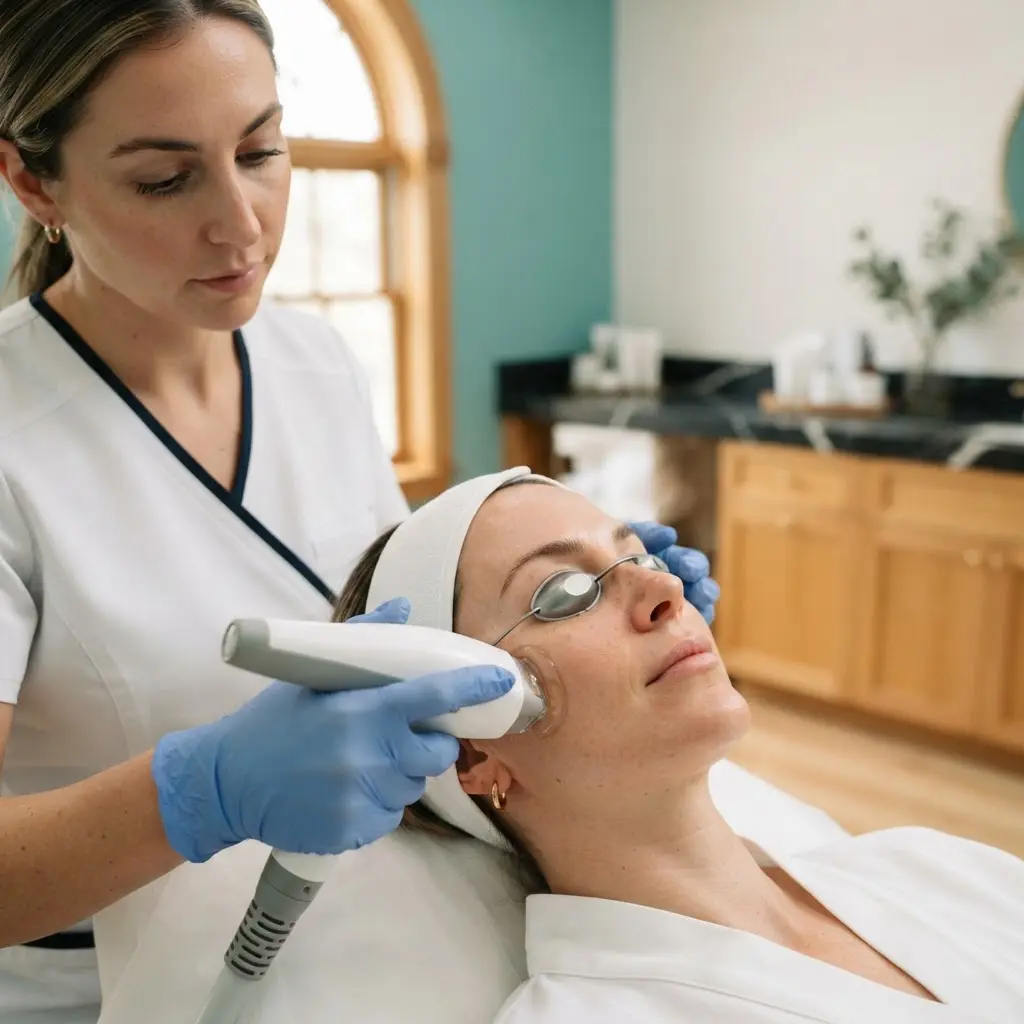
Twenty to 40 minutes is typical. Our medical esthetician will cleanse your skin, give you eye shields, and spread a cold gel across the area. Then the handpiece moves in a grid, one pulse per stamp-sized square. Each pulse is a flash and a snap, “the snapping of rubber bands” in patient reports on RealSelf, and it can feel hot on higher settings. Numbing usually isn’t needed, and if you’re treating red and brown together, we’ll do a second pass with a different filter.
Consult
We’ll look at your spots and redness together, make sure every pigmented spot has been checked for skin cancer, ask about tanning, self-tanner, photosensitizing medications, cold sores, and pregnancy, and choose your filter. If you have a tan or recent sun exposure, we’ll book your session for a later date.
Prep
We cleanse, add eye shields, and apply cold gel. Please avoid retinoids or acids for a few days before, and sun or self-tanner for two weeks.
Treatment
A test pulse first, then a grid across the area, with a flash and a snap per pulse. We’ll add a second filter for vessels if needed. Twenty to 40 minutes.
Before you leave
We remove the gel and finish with a cool compress and sunscreen. You’ll leave with a day-by-day sheet and your next date 3 to 4 weeks out.
Your results
A predictable timeline
Your spots lighten as they shed at 1 to 2 weeks, and redness improves over 2 to 4 weeks as treated vessels close. Each session builds on the one before, and we’ll look at your full series result together one month after the last session.
Day 0
Red and warm for a few hours. A cool compress helps, and it’s best to skip the sauna or hot yoga.
Days 1 to 3
Spots darken into the coffee-grounds look. Makeup with SPF is fine.
Days 4 to 7
Flaking begins as spots lift and shed. Don’t pick.
Weeks 1 to 2
Spots look visibly lighter, and redness starts to settle.
Weeks 3 to 4
Time for your next session. This is when the redness improvement shows.
One month after the last session
We’ll review your series result together and book maintenance for the following autumn.
What it costs
Clear pricing, planned by the visit
Your cost depends on the area (face, neck, chest, hands, or combinations), the number of sessions, and whether a session includes both a pigment pass and a redness pass.
- The area: face, neck, chest, or hands
- The number of sessions
- A pigment pass and a redness pass in one visit
- Whether you start with a single test session
At Skinovatio Lincoln Park
IPL photofacial
$249
to start
- Full face
- $350
- Face and neck
- $549
- Neck
- $350
- Hands
- $249 per session
- Consultation
- $50
- With Afterpay or Klarna
- About $62 × 4 payments
Many people need three full-face sessions for sun damage. We schedule these in fall and winter only, and you’ll need to avoid sun exposure for two weeks before and after each session.
Book your IPL photofacial appointmentSimilar purpose, different options
IPL or something else?
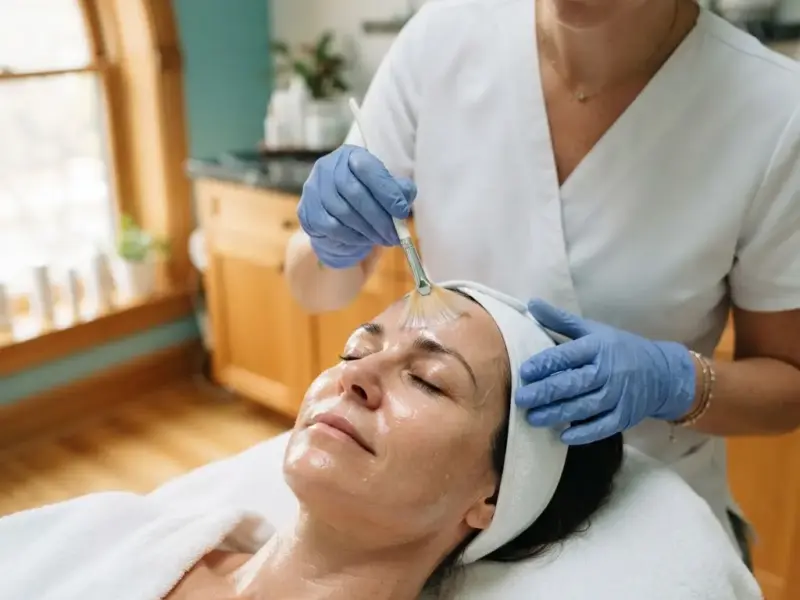
Chemical peels work on surface pigment by flaking, not by heating it. They’re safer for melasma and for skin types V and VI, and they help with texture and acne marks that IPL doesn’t touch. IPL clears a discrete sun spot more reliably than a peel does, so many of our winter plans use both.
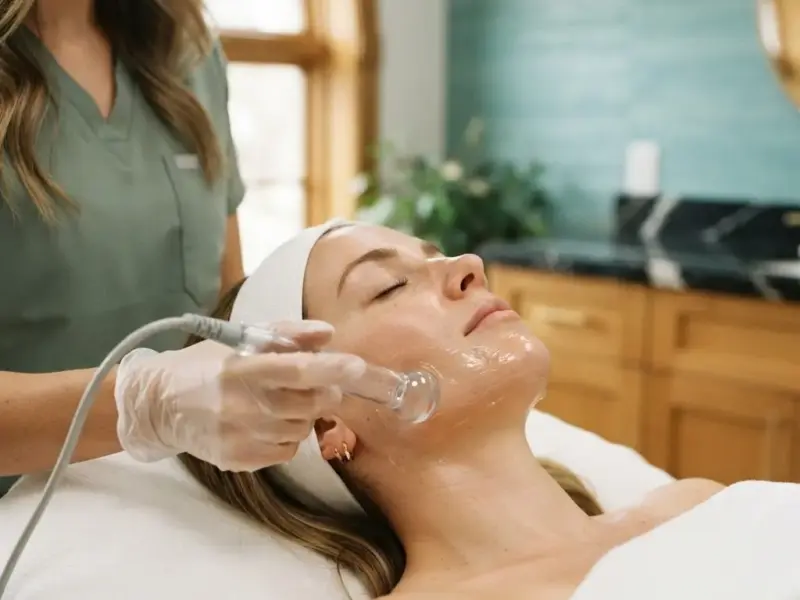
Forma is radiofrequency for laxity, not light for color. If you’re noticing a softer jawline as well as brown spots, IPL can take care of the color and Forma the tightening, often in the same October-to-April series.
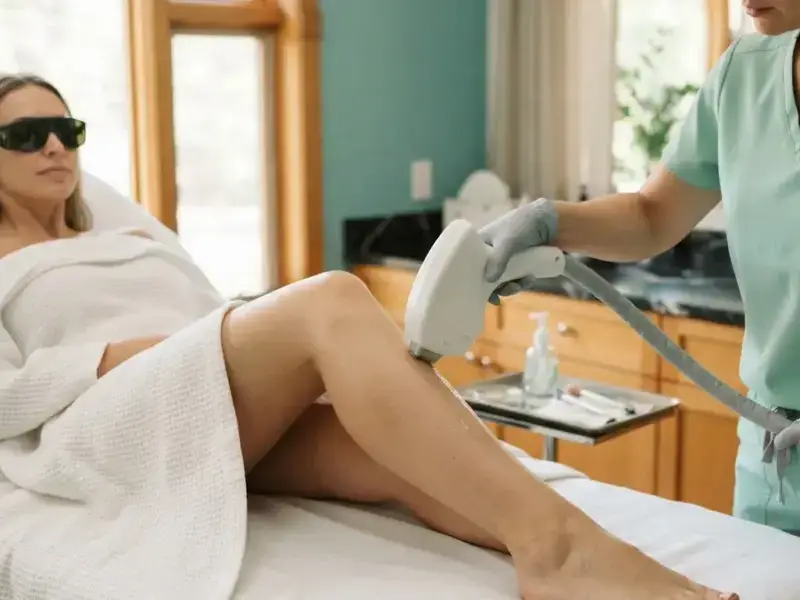
Laser hair removal on the GentleMax Pro is the better choice if hair is what you’d like to address. The evidence for long-term reduction is with lasers, per Haedersdal and Wulf, and the 1064 nm Nd:YAG covers darker skin that IPL can’t.
| Brown | Red | |
|---|---|---|
| What IPL targets | Melanin in sun spots and freckles | Hemoglobin in small vessels |
| What you see that week | Spots darken, then flake by day 7 | Flushed, sometimes faintly bruised |
| When it shows | 1 to 2 weeks | 2 to 4 weeks |
| Sessions | 3 to 5 | 3 to 5 |
| Better to skip IPL if | Melasma, skin types V and VI | Deep or large veins, darker skin |
| What we’d suggest instead | Chemical peel | GentleMax Pro vascular setting |
What IPL targets
- Brown
- Melanin in sun spots and freckles
- Red
- Hemoglobin in small vessels
What you see that week
- Brown
- Spots darken, then flake by day 7
- Red
- Flushed, sometimes faintly bruised
When it shows
- Brown
- 1 to 2 weeks
- Red
- 2 to 4 weeks
Sessions
- Brown
- 3 to 5
- Red
- 3 to 5
Better to skip IPL if
- Brown
- Melasma, skin types V and VI
- Red
- Deep or large veins, darker skin
What we’d suggest instead
- Brown
- Chemical peel
- Red
- GentleMax Pro vascular setting
Is it right for me?
Who it’s for, and who it isn’t
IPL is a good fit if you have skin types I to IV, brown or red damage in the surface layers, and can keep the treated skin out of direct sun for two weeks on either side of each session. In Chicago, that usually means October to April. Every pigmented spot gets checked for skin cancer before it’s treated, and if one looks off, we’ll refer you to a dermatologist first.
A good fit for
- Sun spots, freckles, and blotchy sun damage on lighter skin
- Diffuse redness, rosacea flushing, and broken capillaries
- Small facial veins beside the nose and cheeks
- Fitzpatrick types I to IV
Not recommended
- Darker skin types (the light heats the top layer and can burn)
- Tanned skin or self-tanner, or a beach week coming up
- Melasma, IPL can make it worse; a peel fits better
- During pregnancy, or on photosensitizing drugs
IPL platforms are FDA-cleared for specific lesions, not for “rejuvenation.” It won’t work on tanned skin, isn’t for darker skin, isn’t a wrinkle or tightening treatment, and spots can return if sun habits don’t change.
In detail
What it treats
This covers sun spots, flat freckling across the cheekbones, and the mottled tone on the chest and the backs of your hands. Across clinical trials, IPL cleared solar lentigines in 74.6 to 90 percent of cases, with less post-inflammatory darkening than freezing them, per a 2025 systematic review. That beats a TCA peel on the same spots by a wide margin.
This covers rosacea flushing, the diffuse pink across your nose and cheeks that cold wind can make worse, and the individual broken capillaries beside the nose. IPL heats the hemoglobin in those small vessels so they close and fade. It’s a job IPL does better than most single-wavelength lasers, because it can cover a whole cheek in just a few pulses.
Many people have both. Sun exposure can leave brown spots and redness in the same area, and a photofacial treats both, sometimes with two filters.
Melasma: IPL is on the cleared indication list for it, but we still don’t start with it, because melasma is an inflammatory, recurring disorder that light can trigger into a rebound. The AAD frames light devices as an add-on for people already on topical medication and strict sun protection, per its melasma treatment page. Chemical peels are the safer first step. For darker skin types V and VI, the broad spectrum is absorbed by the skin’s own pigment, so the risk of burns and pigment changes goes up. Trials enrolled skin types I to IV, per the 2022 systematic review, and that’s where we keep it. If you have a tan, including self-tanner, we’ll need to reschedule your visit.
How it works
A flash lamp fires filtered light into the skin. Melanin in a sun spot and hemoglobin in a vessel absorb that light more than the skin around them, so the target heats and the surroundings don’t. Dermatologists call it selective photothermolysis, per Goldman, Weiss, and Weiss. The heated pigment lifts to the surface and sheds over about a week. The heated vessel closes and fades over a few weeks.
A 2022 systematic review of 16 studies with 637 participants found IPL effective for telangiectasia, redness, sun spots, texture, pores, and overall photoaging score, at an average of 4.29 sessions. It also noted that nine of the studies were of low quality and that there’s no consensus on settings. The effect is real, but protocols vary by clinic, which is why the hands doing your treatment matter.
Our platform is InMode Lumecca. IPL platforms are FDA-cleared for benign pigmented and vascular lesions, and “photofacial” is the marketing name for treating those lesions across a whole face. It’s FDA-cleared, not FDA-approved, and it isn’t a laser.
Afterwards
Downtime and aftercare
Day 0: you’ll be red, warm, and a little swollen for a few hours. A cool compress helps. It’s best to skip hot yoga, the sauna, or hard workouts that night.
Days 1 to 7: the brown spots darken and take on what patients on RealSelf call a coffee-grounds look, then flake off over several days. That’s expected. Redness from a vascular pass can look bruised at higher settings for a couple of days.
Day 7 onward: the flakes are gone, and your spots look lighter.
Aftercare is simple: wear sunscreen every morning, keep the area out of the sun for two weeks after, leave the flakes alone, stick to gentle skincare, and pause retinoids or acids for a few days.
Planning around the darkening days
The darkened spots are visible, so it helps to plan around them as you would a peel. A Thursday session puts the darkest days over the weekend and the flaking on Monday and Tuesday, when makeup can cover it. A Monday session puts the darkest days on Wednesday and Thursday.
Why here
Why Lincoln Park
IPL is best scheduled in the lower-sun months, because treated skin needs to stay out of the sun for two weeks on either side of each session. If you start in October, three to five sessions finish by March. From May through September, we limit treatment to one maintenance session for skin that’s been well protected from the sun.
For a wedding or other event, your last session should be four weeks before. Rosacea treatment follows the same winter schedule.
You’ll find us on Lincoln Avenue just north of Wrightwood, a block up from the Apollo Theater. Take the Brown Line to Diversey and head south, or the Red, Brown, or Purple Line to Fullerton and head north. The 11 Lincoln bus runs right past our door. There are meters on Lincoln, and free side-street parking west of Clark if you check the cleaning signs. Your IPL treatment here is done by our medical esthetician, and the map and hours are on the page for our Lincoln Park med spa.
Questions
Common questions, answered
IPL, intense pulsed light, is a filtered flash of broad-spectrum light, roughly 500 to 1,200 nanometers, aimed at brown pigment and red vessels in the skin. It’s not a laser. Sun spots absorb the light, darken, and flake off over about a week. Small vessels close and fade over a few weeks. A photofacial is simply IPL applied across the whole face, usually in 3 to 5 sessions.
IPL works well for diffuse redness and rosacea flush across a cheek, because it covers a large area in a few pulses and treats brown at the same time. A vascular laser, such as the 1064 nm setting on the GentleMax Pro, suits individual larger vessels and darker skin, where IPL isn’t safe. At Skinovatio Lincoln Park, we’ll help you choose between them at your consult based on vessel size and skin type.
Yes, it can help with the flushing and the visible vessels. Rosacea is on the FDA-cleared indication list for IPL platforms, and a 2022 systematic review found IPL effective for erythema and telangiectasia. It doesn’t cure rosacea or treat the bumps and pustules, which need a prescription from a dermatologist. You can expect 3 to 5 sessions, plus a maintenance session or two a year.
It can, but it can also make it worse, which is why we don’t start with it. Melasma is an inflammatory pigment disorder that rebounds after heat and light. The American Academy of Dermatology positions light devices as an add-on for people already on topical medication and strict sun protection. For melasma, we’ll start you with a series of light chemical peels and sunscreen, and add IPL only if a medical plan is already in place.
About a week. The spots darken over days 1 to 3, take on a coffee-grounds look, and flake off over days 4 to 7. By the end of the second week, they’re visibly lighter. Don’t pick or scrub them, because picking can turn a lightening spot into a dark mark.
Three to four weeks. That gives the pigment time to shed and the vessels time to close before the next pass. A full series is 3 to 5 sessions, so plan on three to four months from your first visit to your last, and one more month before we look at the final result together.
Not while you still have a tan. Your skin needs two weeks with no sun or self-tanner before a session, and a summer tan often holds longer than that on the chest. In practice, the first session usually lands in October, once the tan has faded and sun exposure is lower. If you’ve used consistent sun protection all summer, we may be able to start earlier.
Yes. Sun spots and blotchy tone on the chest and the backs of the hands respond to IPL, and both are common areas for sun damage. They respond more slowly than the face and need the same two-week sun rules, so we run chest and hand series in winter.
We’d hold off. The darkening and flaking week would fall right before the event, and any redness pass can look bruised for a couple of days. Your last session should be four weeks out. A 3 to 5 session series takes three to four months, so plan your start date around that, and allow extra time if the chest is included.
The IPL platform at Skinovatio Lincoln Park is InMode Lumecca. IPL platforms are FDA-cleared for benign pigmented and vascular lesions, which includes sun spots, freckles, broken capillaries, and rosacea. At your consult, we’ll explain which filters we’ll use for your skin and why, and whether your skin type rules the device out.
IPL is not reversible, so careful screening is part of every IPL plan. We test a small area first, and if your skin type or a recent tan makes burns or pigment changes likely, we won’t treat, and we’ll recommend a better option instead.
Keep exploring
Related treatments
Related priorities
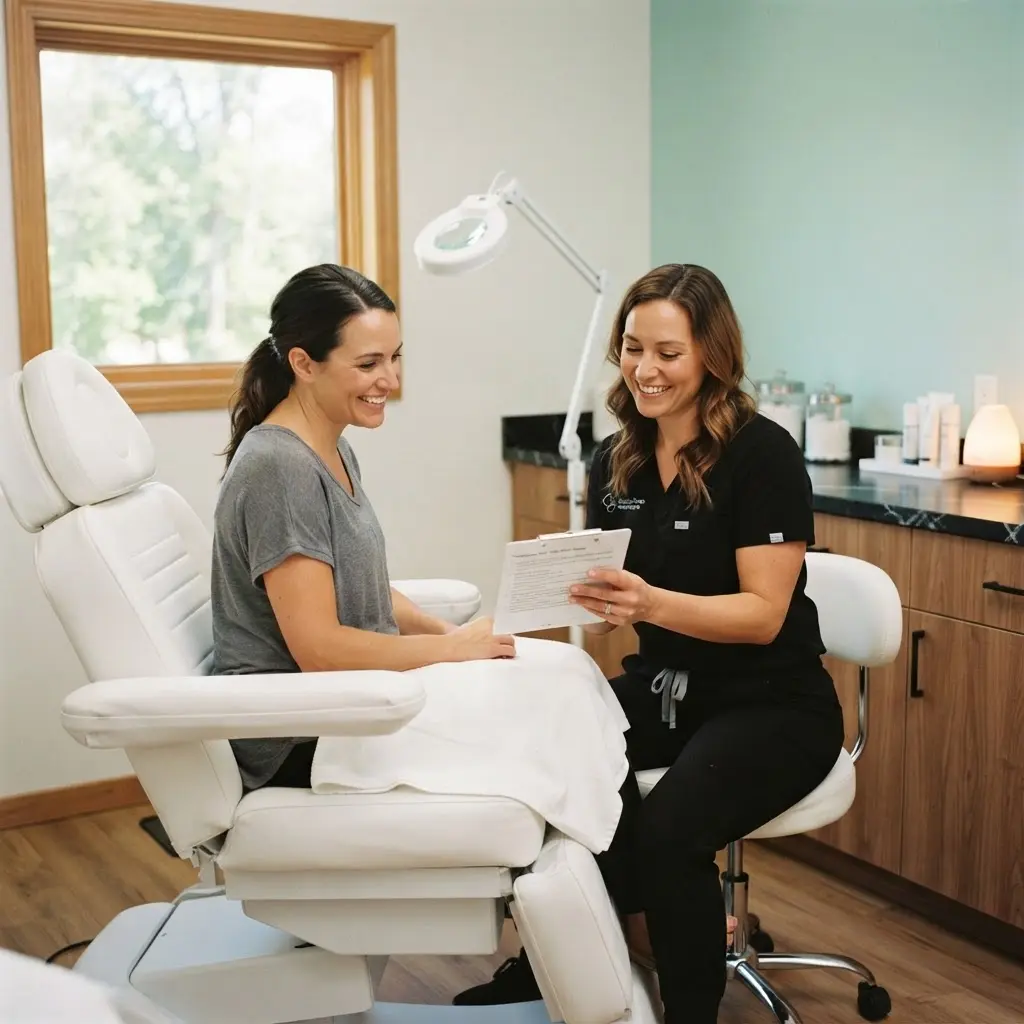
Start with a consult
Tell us what you’d like to work on. We’ll assess your skin and goals, walk you through your IPL photofacial options, and give you a clear plan and price before anything begins.
Afterpay and Klarna are available at checkout for eligible treatments.