
Priorities
Redness and rosacea
Persistent flushing, visible capillaries, and reactive skin, with treatment to reduce redness over time.
Facial redness often starts as flushing that fades quickly after heat, sudden temperature changes, or alcohol. Over time, some of the color can become persistent, and a web of tiny vessels may appear beside the nose that concealer sits on rather than covers.
This pattern usually points to rosacea, sun damage with broken capillaries, or, most often, some of both. Neither can be cured with in-office treatment, but both can be reduced and managed.
What we'd want you to know
Rosacea can be managed, even though it can't be cured
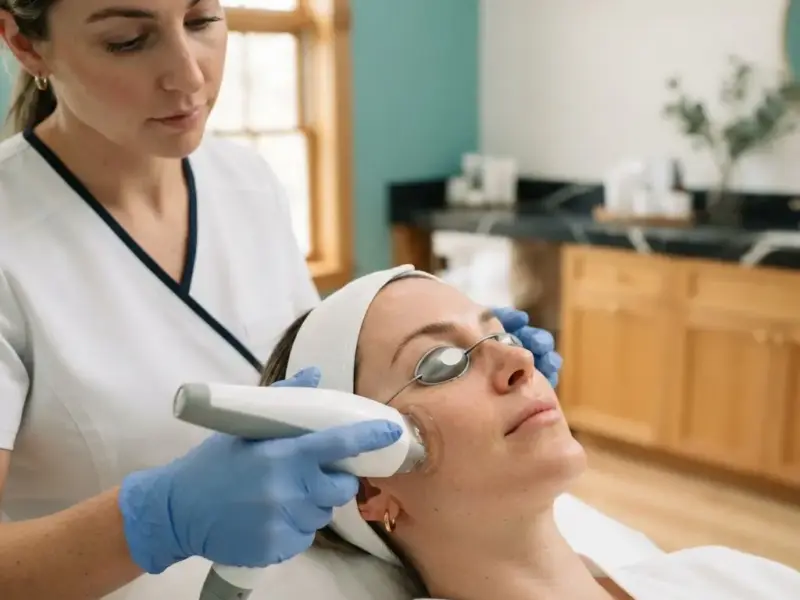
For fixed redness and visible vessels on lighter skin, we’d suggest IPL: three to five sessions, three to four weeks apart, with our medical esthetician. Filtered light heats the blood in small vessels until they close. We schedule it from October to April, when sun exposure is lower.
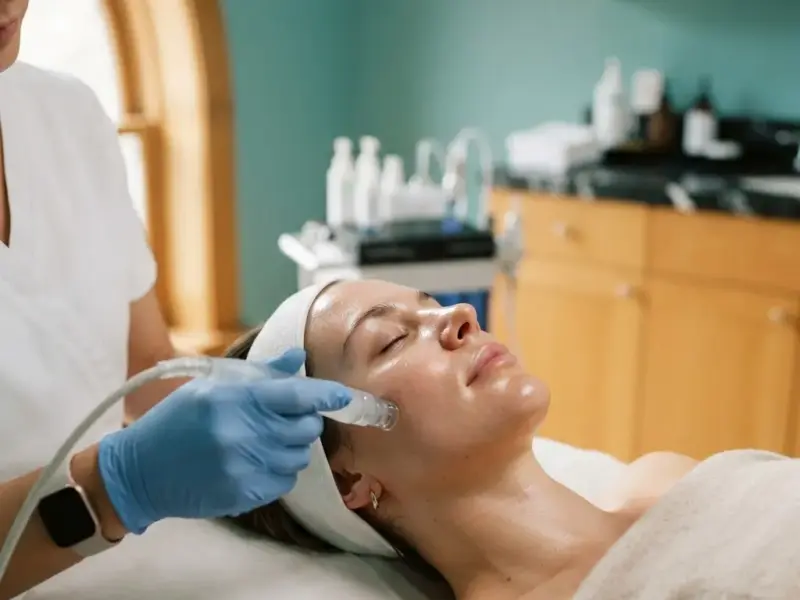
For maintenance, we’d suggest a HydraFacial MD every eight to twelve weeks, with no peel step and no heat. The oxygen facial isn’t on the Lincoln Park booking menu, but if suction is too much for your skin, we can arrange it by request.
How we evaluate redness and rosacea
We’ll start with four questions: what triggers it, whether there are pustules with the red, whether a dermatologist has seen it, and what your skin tone is. Pustular rosacea needs a prescription first, and we won’t use light-based treatment until it’s under control.
For fixed red and visible vessels, we use IPL, FDA-cleared for benign vascular lesions including telangiectasias and rosacea. The physics: hemoglobin absorbs the filtered pulses more than the surrounding skin does, so the vessel heats, seals and fades while the surface is spared, per Goldman and colleagues in Dermatologic Surgery. You can expect less background red two to four weeks after a session, and we’ll assess the overall result a month after your last session. IPL is for skin types I to IV only. Individual results vary.
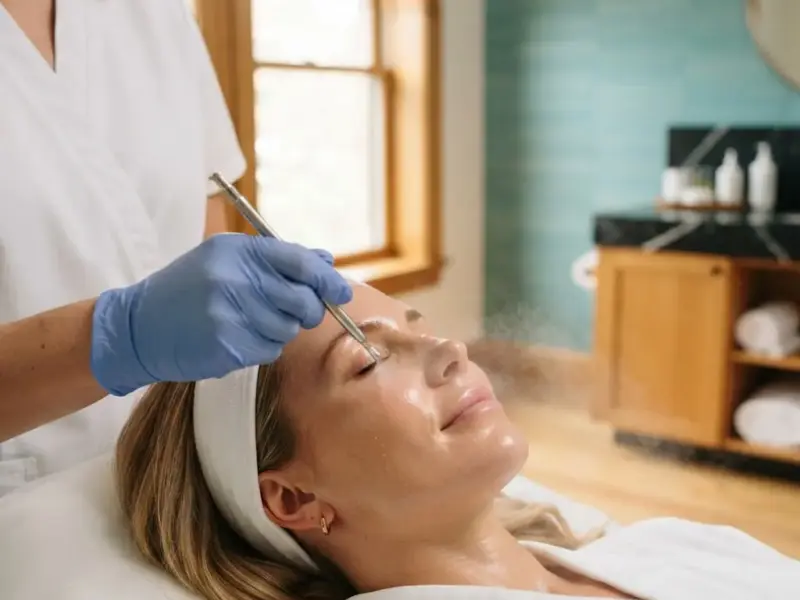
Between series, rosacea-prone skin does best with minimal intervention. A HydraFacial on its lowest setting, with the peel step off, is fine outside a flare, and we’ll skip it on a flare day. The oxygen facial is available by request for skin that can’t take any suction.
That means avoiding heat, abrasion, steam, and strong acids. Mention rosacea when you book, and we’ll prepare the treatment room accordingly.
Your questions, answered
How many IPL sessions for redness?
Plan on three to five, three to four weeks apart, all between October and April. Most people see the background red drop after the second session. After that, one or two sessions a year help hold it, because rosacea keeps producing vessels.
How red will I be the afternoon after IPL?
Mildly. Expect pinkness and warmth for a few hours, occasionally with a faint bruise at a higher setting. Your skin is usually back to normal by the next morning, so a late-day appointment allows the evening for redness to settle.
Is rosacea worse in a Chicago winter?
It can be. Forced-air heat pulls indoor humidity down to 10 to 15 percent, and cold wind chaps skin that’s already reactive. Day to day, a bland moisturizer, a humidifier, and a mineral sunscreen make more difference than any in-office treatment.
Related treatments
From the clinic
Local · 5 min read
Lakeview, Wrigleyville, and Lincoln Square: how to choose a med spa when five are on your Brown Line
It helps to choose a med spa on six questions rather than distance alone: who injects, which device, whether they price by the plan, whether they'll…
Compare and decide · 6 min read
Microneedling vs chemical peel: pick by problem, not by trend
The simplest way to choose is to consider where the problem is. Scars, pores, and fine lines sit in the dermis, where needles can reach them.…